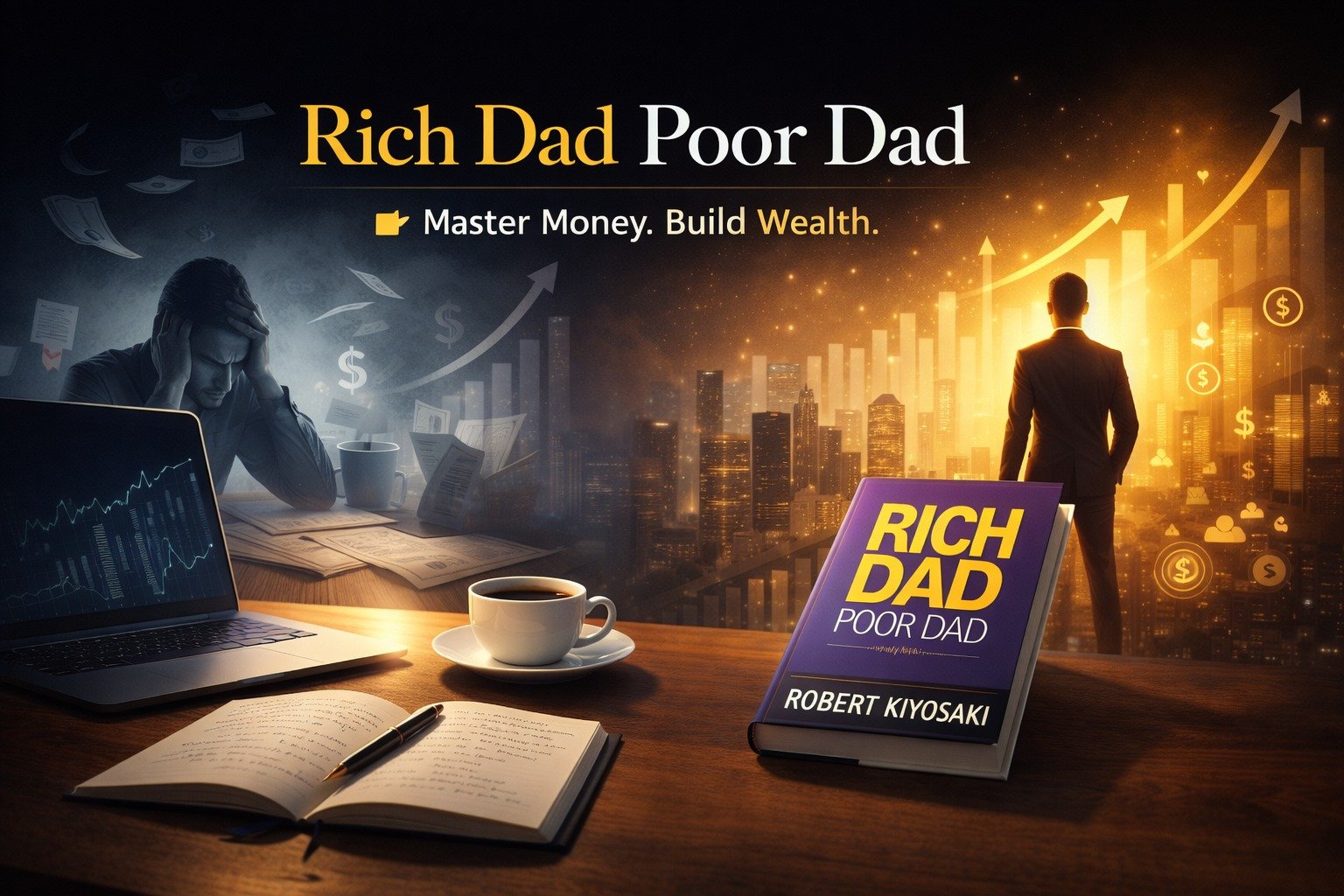
When it comes to personal finance books that have changed millions of lives, Rich Dad Poor Dad by Robert Kiyosaki stands at the top of the list. First published in 1997, this book became a global bestseller and continues to influence readers even decades later.
⭐ Overall Rating
⭐⭐⭐⭐⭐ (5/5)
The book challenges traditional beliefs about money, job security, and education. Most of us grow up hearing the same advice:
Study hard.
Get good grades.
Find a secure job.
Work for 30–40 years.
Retire comfortably.
But despite following this path, many people struggle financially. Salaries increase, but expenses increase faster. Promotions come, but financial freedom feels distant.
Rich Dad Poor Dad introduces a different philosophy:
The rich don’t work for money. They make money work for them.
This complete book review explores the book’s summary, key lessons, financial principles, strengths, weaknesses, and why it remains relevant today.
About the Author – Robert Kiyosaki
Robert Kiyosaki is an American entrepreneur, investor, and motivational speaker best known for the Rich Dad series. He focuses on financial education, entrepreneurship, investing, and wealth-building strategies.
Through this book, Kiyosaki shares lessons he learned from two father figures in his childhood — his biological father (Poor Dad) and his best friend’s father (Rich Dad).
Overview of Rich Dad Poor Dad
The book is structured around the financial philosophies of two men:
Poor Dad
- Highly educated
- Believed in job security
- Focused on academic success
- Encouraged stable employment
- Struggled financially despite steady income
Rich Dad
- Entrepreneurial mindset
- Believed in financial education
- Invested in assets
- Built businesses
- Achieved financial independence
Through these contrasting viewpoints, the book explains why traditional education often fails to teach financial intelligence.
Core Financial Lessons from Rich Dad Poor Dad
The Importance of Financial Education
One of the strongest messages in Rich Dad Poor Dad is that schools do not teach financial literacy.
Students learn mathematics, science, and history — but rarely learn about:
- Taxes
- Investing
- Cash flow
- Debt management
- Business ownership
Kiyosaki argues that financial education is more important than academic degrees when it comes to building wealth.
High income does not guarantee financial security. Financial knowledge does.
Assets vs Liabilities – The Foundation of Wealth
This is the most famous concept from Rich Dad Poor Dad.
Assets put money in your pocket.
Liabilities take money out of your pocket.
According to Kiyosaki:
Assets
- Rental real estate
- Stocks and dividends
- Businesses
- Royalties
- Investments generating income
Liabilities
- Car loans
- Credit card debt
- EMI-based purchases
- Luxury items without income return
- Personal residence (if it does not generate cash flow)
This idea challenges conventional thinking. Many people believe owning a home is always an asset. Kiyosaki argues that unless it generates income, it may function as a liability.
Wealthy individuals focus on accumulating income-producing assets.
Understanding the Rat Race
The “Rat Race” is the cycle most people get trapped in:
Earn money → Pay bills → Increase expenses → Work harder → Repeat
As income rises, lifestyle expenses increase too. This creates dependency on salary.
The only way to escape the rat race is:
- Reduce liabilities
- Increase assets
- Build passive income
Financial freedom occurs when passive income exceeds monthly expenses.
Why the Rich Don’t Work for Money
Most employees exchange time for money.
The wealthy build systems and assets that generate money without constant involvement.
Instead of working for a paycheck, financially intelligent individuals:
- Start businesses
- Invest in real estate
- Build dividend portfolios
- Create intellectual property
The goal is not to stop working — but to stop depending solely on earned income.
Mindset Matters More Than Money
According to Rich Dad Poor Dad, financial success starts in the mind.
Poor mindset:
- Fear of losing money
- Avoiding risks
- Seeking job security
- Saying “I can’t afford it”
Rich mindset:
- Seeking opportunities
- Taking calculated risks
- Asking “How can I afford it?”
- Investing in learning
The book emphasizes that fear and doubt are the biggest obstacles to wealth.
The Power of Entrepreneurship
Kiyosaki promotes business ownership as a major path to financial freedom.
Employees pay taxes first, then spend what remains.
Business owners:
Earn income → Deduct expenses → Pay taxes on remaining profit
Understanding this difference allows entrepreneurs to build wealth more efficiently.
The book encourages readers to think like business owners rather than employees.
Multiple Income Streams
One key lesson from Rich Dad Poor Dad is never to depend on a single source of income.
Wealthy individuals build:
- Passive income
- Investment income
- Business income
- Portfolio income
In today’s digital economy, income streams may include:
- Online businesses
- Content creation
- Affiliate marketing
- Stock investments
- Real estate
Diversified income increases financial security.
Detailed Summary of Each Section
The book is divided into six main lessons:
Lesson 1: The Rich Don’t Work for Money
Fear and desire drive most people’s financial decisions. The rich learn to control emotions and make logical financial choices.
Lesson 2: Why Teach Financial Literacy?
Understanding financial statements and cash flow is crucial for wealth building.
Lesson 3: Mind Your Own Business
Focus on building assets rather than only climbing the corporate ladder.
Lesson 4: The History of Taxes
Learn how corporations and businesses legally reduce tax burdens.
Lesson 5: The Rich Invent Money
Opportunities are everywhere for those who are financially educated.
Lesson 6: Work to Learn, Not Just to Earn
Develop multiple skills — sales, marketing, communication, investing — to increase opportunities.
Strengths of Rich Dad Poor Dad
- Simple and easy language
- Strong motivational impact
- Clear explanation of financial basics
- Encourages entrepreneurial thinking
- Timeless wealth principles
The book inspires readers to question traditional financial advice.
Weaknesses and Criticism
While the book is powerful, it is not perfect.
- Limited practical investment steps
- Repetition of key concepts
- Oversimplification of complex financial realities
- Some critics question the authenticity of the “Rich Dad” character
However, the book’s goal is mindset transformation, not technical investment training.
Why Rich Dad Poor Dad Is Still Relevant Today
The financial world has changed since 1997, but the book’s principles remain relevant because:
- Job security is decreasing
- Inflation is rising
- Traditional pensions are disappearing
- Entrepreneurship is growing globally
- Digital assets are becoming mainstream
Financial literacy is more important than ever in today’s economy.
Who Should Read Rich Dad Poor Dad?
This book is ideal for:
- Students seeking financial awareness
- Young professionals
- Entrepreneurs and freelancers
- Beginners in investing
- Anyone tired of living paycheck to paycheck
Advanced investors may find it basic, but beginners will benefit greatly.
Practical Takeaways from the Book
After reading Rich Dad Poor Dad, readers should:
- Track income and expenses
- Start investing early
- Build income-generating assets
- Reduce unnecessary liabilities
- Learn about taxes and business structures
- Develop financial confidence
The book encourages action rather than passive reading.
Final Verdict
Rich Dad Poor Dad is not just a personal finance book — it is a mindset revolution.
It changes how you think about:
- Jobs
- Education
- Investing
- Risk
- Wealth
While it may not provide detailed stock market strategies, it lays the foundation for financial intelligence.
If you are beginning your financial journey, this book is a powerful starting point.
Overall Rating
5 out of 5
Best for: Beginners, students, and aspiring entrepreneurs
Not ideal for: Advanced investors looking for technical strategies
Conclusion
Financial freedom does not happen by accident. It is built through:
- Financial education
- Smart asset accumulation
- Risk awareness
- Strong mindset
Rich Dad Poor Dad teaches that wealth is not about earning more — it is about learning more.
For anyone serious about understanding money and building long-term financial independence, this book remains one of the most recommended reads worldwide.
 Visit: https://blogsflow.com/work-with-me/
 Email: info@blogsflow.com