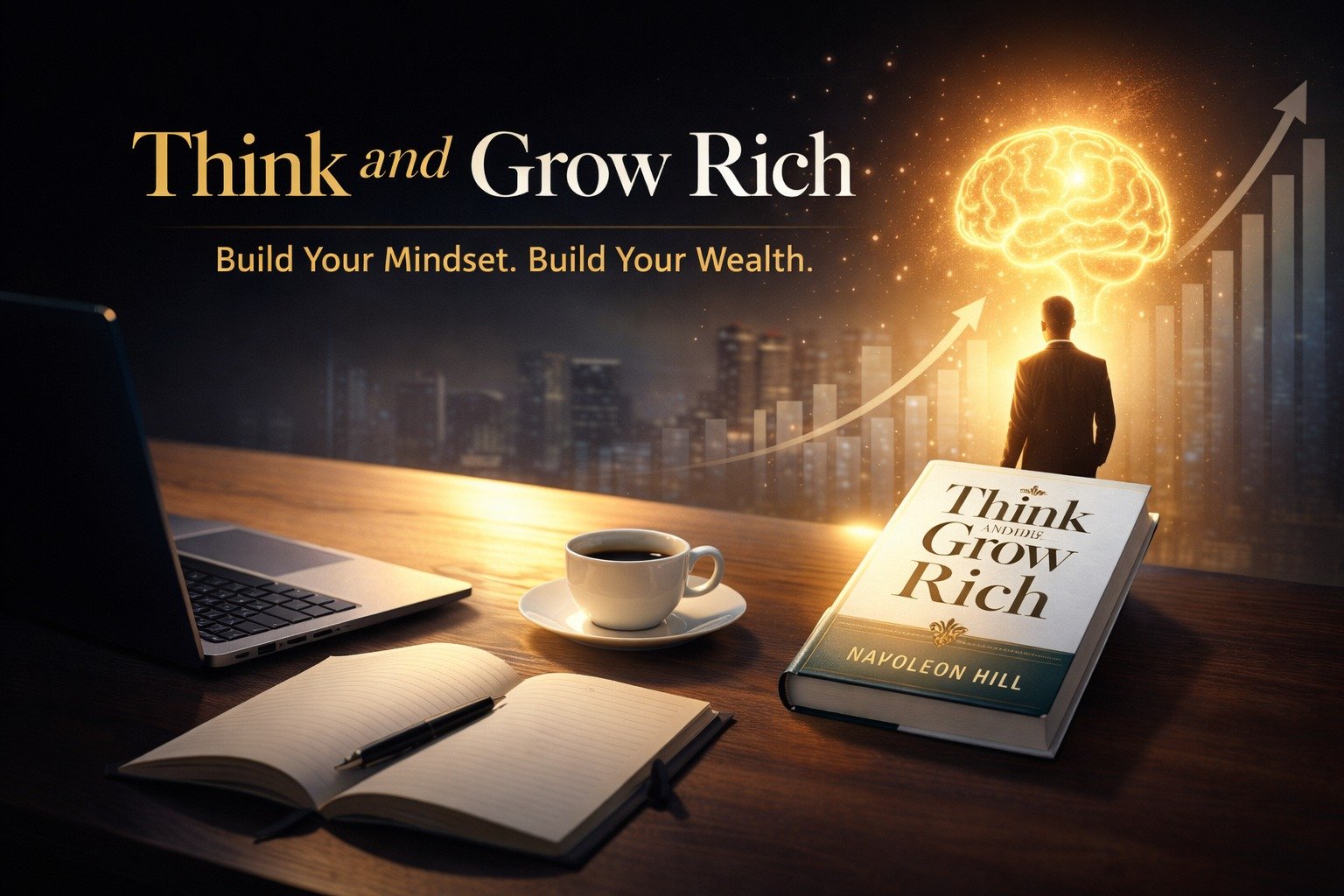
When we talk about personal development classics that have shaped generations of entrepreneurs, leaders, and wealth creators, one name stands above the rest — Think and Grow Rich by Napoleon Hill.
First published in 1937, this legendary self-help book is considered one of the most influential success books ever written. But the real question is:
👉 Is Think and Grow Rich still relevant today?
👉 Does it really help people become rich?
👉 Or is it just motivational theory?
In this complete book review, we will break down everything — from its core philosophy and chapter-wise concepts to real-life applications, strengths, weaknesses, and whether it truly deserves its legendary status.
⭐ Overall Rating
⭐⭐⭐⭐⭐ (4.8/5)
Category: Personal Development / Wealth Mindset
Best For: Entrepreneurs, students, professionals, creators, and anyone serious about success
Verdict: A timeless blueprint for building a success-oriented mindset.
About the Book Think and Grow Rich
Napoleon Hill claimed that he spent over 20 years studying some of the wealthiest and most successful individuals of his time. He analyzed their habits, mindset, decision-making, and philosophies to identify the common principles behind their achievements.
The result was Think and Grow Rich — a book that focuses less on “how to make money” and more on how to think like a successful person.
One of the most powerful lines from the book is:
“Whatever the mind can conceive and believe, it can achieve.”
This sentence summarizes the entire philosophy of the book.
Hill argues that:
- Thoughts become things
- Beliefs shape reality
- Success starts in the mind before appearing in the physical world
Core Philosophy of Think and Grow Rich
Unlike traditional finance books, this book does not teach investment strategies or business models.
Instead, it teaches:
✔ Mindset mastery
✔ Goal clarity
✔ Self-discipline
✔ Emotional control
✔ Persistence
✔ Strategic networking
Hill believed that wealth is a by-product of correct thinking patterns.
Detailed Breakdown of the 13 Principles
The book is structured around 13 success principles. Let’s explore them in depth.
Desire – The Starting Point of All Achievement
Hill emphasizes that success begins with a burning desire — not a casual wish.
He suggests writing down:
- The exact amount of money you want
- What you will give in return
- The deadline
- A clear plan of action
This clarity transforms vague dreams into actionable goals.
👉 Weak desire produces weak results.
👉 Obsession with a goal creates momentum.
Faith – The Power of Belief
Faith is described as a mental state that can be developed through repetition and affirmation.
Hill explains that when you repeatedly tell yourself something with emotion, your subconscious accepts it as truth.
Over time, this belief influences your decisions and behavior.
This idea connects deeply with modern psychology and manifestation practices.
Autosuggestion – Programming the Mind
Autosuggestion is the method of influencing your subconscious mind through repeated thoughts and affirmations.
Hill recommends:
- Reading your goals daily
- Visualizing success
- Repeating positive statements with emotion
Today, this principle is widely used in performance psychology and coaching.
Specialized Knowledge
General knowledge is not enough to create wealth.
Hill stresses the importance of:
- Acquiring specialized skills
- Continuously learning
- Applying knowledge strategically
In today’s digital economy, this principle is more relevant than ever.
Imagination
Hill divides imagination into:
- Synthetic imagination (rearranging existing ideas)
- Creative imagination (creating new concepts)
Innovation and entrepreneurship rely heavily on imagination.
Every successful product or business began as an idea.
Organized Planning
Desire without planning leads to frustration.
Hill advises:
- Creating detailed action plans
- Adjusting strategies when needed
- Learning from temporary defeat
Success is not random — it is planned.
Decision
Successful people make decisions quickly and change them slowly.
Unsuccessful people do the opposite.
Indecision leads to doubt, fear, and missed opportunities.
Persistence
Persistence is one of the strongest themes in the book.
Most people fail not because they lack talent — but because they quit too soon.
Hill lists common causes of failure:
- Fear of criticism
- Fear of poverty
- Lack of confidence
- Lack of clear goals
Persistence eliminates these weaknesses.
The Mastermind Principle
One of the most powerful ideas in the book is the Mastermind concept.
Hill explains that when two or more people coordinate in harmony toward a goal, their collective intelligence multiplies.
This principle highlights:
- Networking
- Mentorship
- Collaboration
No great success is built alone.
The Subconscious Mind
The subconscious mind acts on dominant thoughts.
If you constantly think about fear and limitation, you attract failure.
If you focus on growth and opportunity, your actions align accordingly.
Modern neuroscience supports the idea that repeated thoughts shape neural pathways.
The Brain as a Broadcasting Station
Hill describes the brain as a “transmitter and receiver” of thoughts.
Though this concept feels mystical, it aligns with modern ideas about energy, focus, and intention.
The Sixth Sense
The final principle discusses intuition.
Hill believed that after mastering the previous principles, individuals develop sharper instincts and decision-making abilities.
This “sixth sense” guides them toward better opportunities.
Why Think and Grow Rich Still Matters Today
Despite being written nearly 90 years ago, the book remains relevant because:
✔ Success psychology does not change
✔ Human fears remain the same
✔ Mindset still determines financial growth
✔ Belief still drives action
In today’s competitive digital world, mindset is often the biggest differentiator between average and extraordinary results.
Practical Applications in Modern Life
Here’s how you can apply the book today:
- Set specific income goals
- Create daily affirmations
- Build a mastermind group
- Develop high-value skills
- Practice consistent action
- Eliminate negative influences
The book becomes powerful only when implemented.
Criticism & Limitations
While powerful, the book has some drawbacks:
- Repetition of ideas
- Old-fashioned writing style
- Some concepts feel abstract
- Lack of modern financial strategies
However, the psychological insights remain highly valuable.
Who Should Read Think and Grow Rich?
This book is ideal for:
- Aspiring entrepreneurs
- Students aiming high
- Freelancers and creators
- Sales professionals
- Business owners
- Anyone stuck in self-doubt
If you want to change your income, you must first change your thinking.
Final Verdict – Is It Worth Reading?
Absolutely.
Think and Grow Rich is not a “get rich quick” guide.
It is a mindset transformation manual.
If you read it once, you may feel inspired.
If you study and apply it consistently, you may:
✔ Develop stronger confidence
✔ Overcome fear
✔ Take bold decisions
✔ Build financial discipline
✔ Achieve long-term success
Conclusion
Success is not accidental.
It is intentional.
Napoleon Hill’s philosophy teaches that:
- Thoughts shape beliefs
- Beliefs shape actions
- Actions shape results
Wealth begins internally before appearing externally.
If you are serious about growth, this book deserves a place in your personal library.
The blueprint is already written.
The only question is — will you apply it?
 Visit: https://blogsflow.com/work-with-me/
 Email: info@blogsflow.com